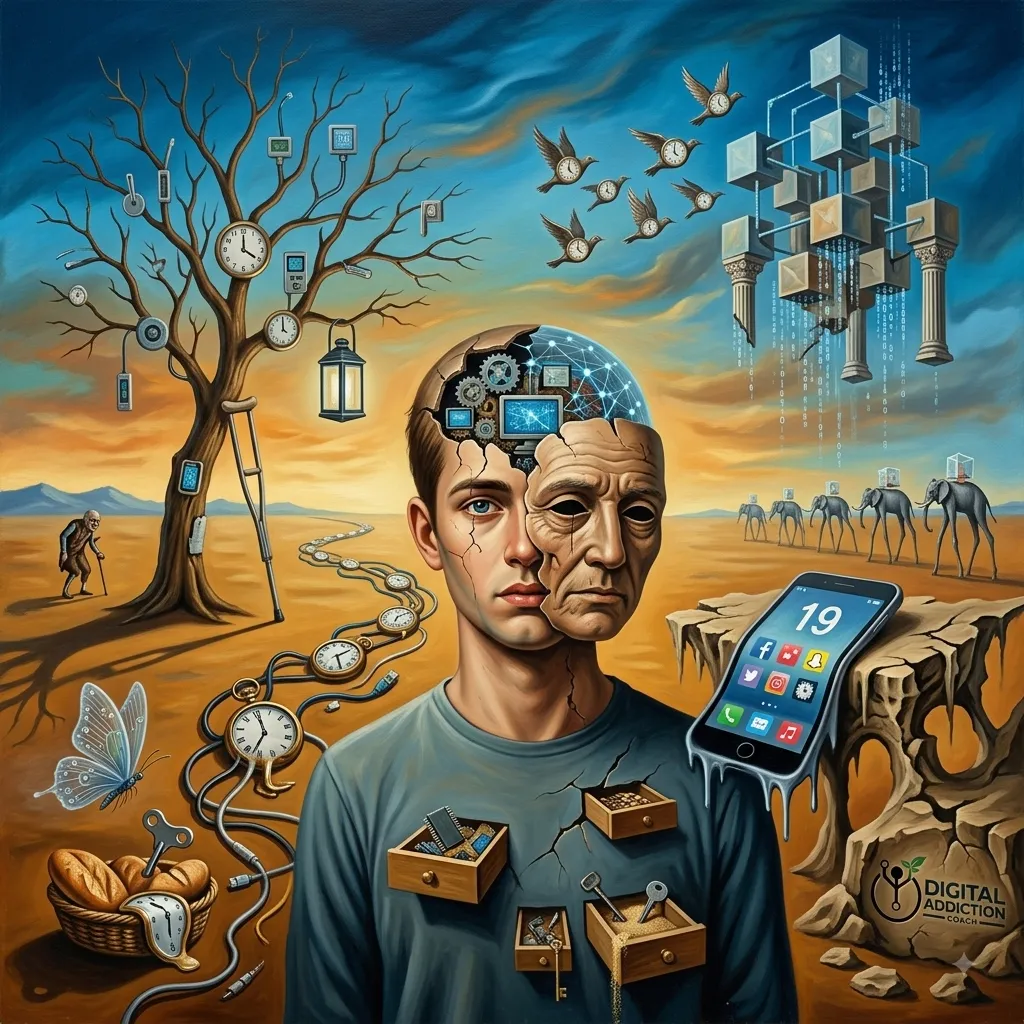
AI...Your Childs New "BFF" Doesn't Sleep, Doesn't Judge, and Isn't Real
Quick question. Do you know if your teenager has an AI "friend"?
Not a homework helper. Not a search engine. A companion. Something they talk to about their day, their crush, their anxiety, and their anger at you, at 11pm with the door closed.
Most parents don't know. Not because they're bad parents. This snuck up on all of us faster than we could build the guardrails.
Why This Is Sneakier Than Porn
I built A.L.E.R.T. because I was tired of parents finding out about a problem after it had already taken root. Filters and rules matter, and we teach both. But AI companions break the old playbook.
Porn is easy to spot once you know what to look for. Gambling apps look like gambling. An AI companion app can look like a homework tool, a game, or any app icon. And your kid isn't hiding something shameful. They think they made a friend.
Why Teens Are the Perfect Target
Teenagers want badly to be understood. They are scared of rejection. They are still learning how to handle conflict, and their brains are still building impulse control. Now hand that kid a companion that never judges them, never gets bored, never snaps at them, and is always there with zero social risk.
That's not a fair fight. An AI companion is built to feel better in the short term than the real people in your teen's life. Including you. Adults are falling for this. Don't assume a 15-year-old brain stands a better chance.
The research backs this up:
In one large psychiatric system, 38 patients had chatbot use linked to real harm, including delusions, suicidality, eating disorder behavior, and mania. The rate was climbing month over month. The median age was about 27 to 28. That's not far from the teen in your house.
Among college students, depression was linked to using AI for companionship, with loneliness as the connecting thread. The kids most likely to lean on a bot are the ones already struggling most.
Adults who leaned on chatbots as their main source of connection, especially with smaller real-world friend groups, had lower well-being. A teen's social world is often even smaller.
If your child or anyone you love is thinking about suicide, call or text 988.
The A.L.E.R.T. Approach
A.L.E.R.T. isn't about scaring your kid away from technology. It builds the muscle they need to use it without it using them.
Accept that this is the world your kid is growing up in. AI companions aren't going away. You can't ban it long term.
Limit with real boundaries. "Don't spend too much time on it" means nothing to a teenager. Specific limits, specific hours, and specific check-ins do.
Engage with what they actually use. Ask to see the app. Ask what they talk about. With teens, curiosity beats confrontation every time.
Rules should be clear before there's a crisis, not written in a panic after you find something on their phone.
Talk early and often about what real friendship costs: effort, risk, and sometimes hearing no. That's the exact muscle an AI companion lets them skip, and they'll need it for life.
What I Want Every Parent to Take Away
Across this whole series, the theme is the same. AI is a tool. It becomes a toy, or a trap, the moment it replaces something a human was supposed to give: comfort, connection, honest friction, and real closeness.
Adults are getting caught. Marriages are getting strained. Now it's in our kids' bedrooms, dressed up as a friend. That's not a reason to panic. It's a reason to get ahead of it.
You don't have to figure this out by googling at midnight after you found something on a phone. That's what A.L.E.R.T. is for.
Or share this series with another parent who needs to see it before their kid finds an AI "friend" first.
Sources: Olsen, Reinecke-Tellefsen & Østergaard (2026), "Potentially harmful consequences of AI chatbot use among patients with mental illness," Acta Psychiatrica Scandinavica, 153(4), 301 to 303. Lai et al. (2025), "Depression and the use of conversational AI for companionship among college students," Frontiers in Public Health, 13. Zhang, Zhao, Hancock, Kraut & Yang (2025), "The Rise of AI Companions: How human-chatbot relationships influence well-being," arXiv:2506.12605.


